
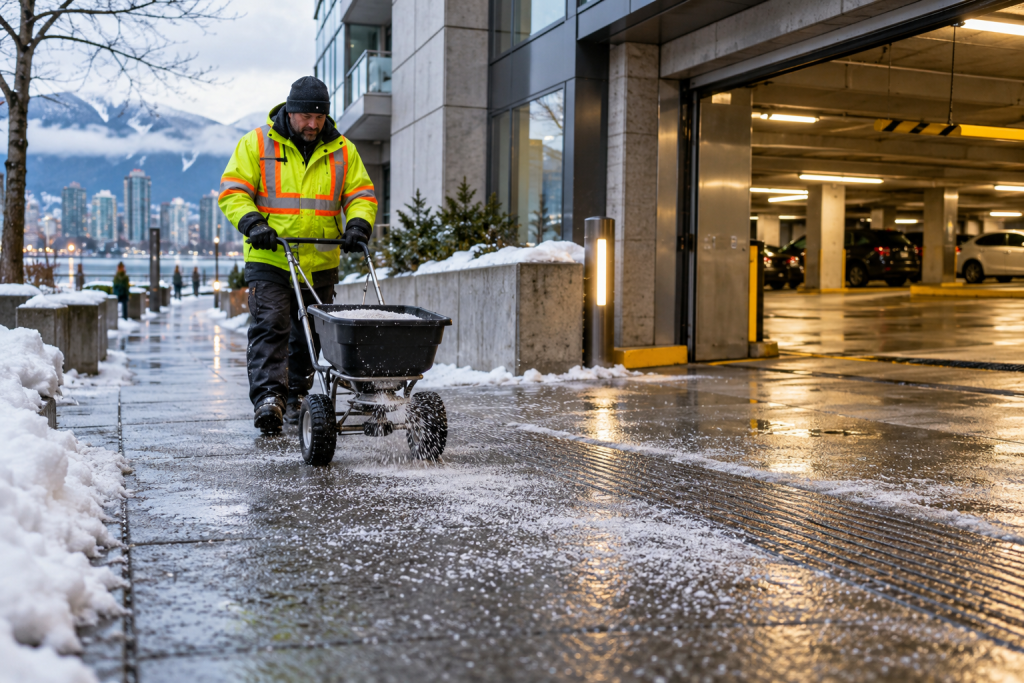
Vancouver winters look easy. But the weather can turn overnight. One cold night can make ice on the ground, and nobody can predict it. If you manage a building, parkade ice removal Vancouver matters a lot. You cannot wait for the first snow to start planning. One icy ramp or one frozen door can cause a bad fall, a fine, a lawsuit, or an angry tenant. By law, sidewalks must be clear by 10 AM the next day. BC law also covers your private property, like your parkade. This guide explains what the law, tenants, and insurers want. It also covers the basics of keeping your building safe during winter.
Why Vancouver Commercial Properties Face High Ice Risk
Freeze-Thaw Black Ice
Vancouver does not get big piles of snow. It gets rain that turns into ice instead. Water sits on the sidewalk all day. At night, the air turns cold. By morning, that water becomes a thin, clear layer of ice. This ice is hard to see. People call it black ice. This is why black ice commercial property problems happen so much near office towers downtown. Tall buildings block the sun, so wet spots stay cold longer than the rest of the street. A good parkade ice removal Vancouver plan checks for this every single week, not just once.
Why Ramps Freeze First
Parking garage ice control problems often start on the ramp first. Ramps are not flat. They go up and down at an angle. Water runs down and pools at the bottom. Wind near the water, like at Coal Harbour or False Creek, makes a ramp colder faster than flat ground. Cars also bring in snow from the road and drip water right at the entrance. When it freezes at night, the ramp often turns icy before anywhere else in the building.
What Tenants Actually Expect From Ice Management
Clear Entry and Ramp Transitions
Tenants care most about the spots where one surface changes into another. This means where the sidewalk meets the door, where the door meets the lobby floor, and where the street meets the ramp. These spots freeze first, and they get missed the most, because crews often clean the middle of a space and skip the edges. Good building entrance ice management means extra care right where people slow down. An entryway ice melt service that only covers the front door is doing half the job.
Pre-Treating Before a Freeze
A tenant does not want to see a salt truck only after the parking lot has turned into a skating rink. They want the ice stopped before it starts. Putting down brine before a cold night stops black ice commercial property problems before they even form. This also saves a sidewalk de-icing Vancouver crew from chipping away at ice that has already stuck to the ground.
Parkade Ramp Safety
Parking garage ice control is more than just the ramp at the front. Open decks at the top of a parkade catch wind and rain directly, so they freeze fast and stay icy longer than the covered levels below. There is another problem too. Cars carry slush on their tires. It melts on the floor, and the inside of the parkade gets just as slippery as outside. A full parkade ice removal Vancouver plan covers both problems, not just one.
Storm Communication
When a big storm hits, tenants want to know what is happening. A short message saying clearing starts at 6 AM, or that one door will be closed for twenty minutes, saves a lot of stress during a busy morning. Staying quiet during a storm makes tenants lose trust fast, even when the parkade ice removal Vancouver crew got the job done well.
What Insurers Expect From Ice Management
Real-Time Service Logs
If a slip-and-fall claim ever comes in, the insurer wants proof, not a guess like “we probably salted that day.” They want real records, the exact time of each visit, the weather at that time, and photos of the cleared area. Without good commercial building snow and ice records, an insurer sees nothing but a guess, and that makes your case weak.
Hold-Harmless Contracts
Insurers also like to see a written contract with a real de-icing sidewalks commercial company, one with a hold-harmless clause. This clause means the contractor takes the blame if they did the work wrong, not the property owner, exactly the kind of protection insurers want before winter starts.
Surface-Safe De-Icers
The type of product matters too. An insurer checking your de-icing sidewalks commercial plan wants to see that you are not just throwing down cheap rock salt everywhere. The wrong product can cause damage, and that damage can turn into its own insurance claim later.
How Ice Control Protects Your Parkade Structure
Salt Damage to Concrete
Rock salt melts ice fast, but it has a hidden cost most people never think about. Salt has chloride in it, and chloride slowly eats away at the steel bars hidden inside parkade concrete. Salty slush drips off cars, sinks into the concrete, and rusts that steel over time. As the steel rusts, it grows bigger, and this makes the concrete around it crack and break apart. This is one more reason de-icing sidewalks commercial work should not use rock salt as the only fix for black ice commercial property risk.
Safer De-Icing Agents
This is why products like calcium magnesium acetate matter for parkade ice removal Vancouver work. This product costs more than rock salt, but it melts ice without hurting the steel inside the concrete. A smart plan uses the gentler product where concrete is showing and saves rock salt for open ground that does not hold weight.
High-Risk Zones at a Glance
Every part of a building deals with winter in its own way. Here is how commercial walkway snow removal, entry care, and parkade control compare across the three spots that cause the most trouble.
| Zone | Main Risk | Tenant Expects | Insurer Requires | Best Practice |
|---|---|---|---|---|
| Sidewalks | Foot traffic packs snow into ice | Clear path before business hours | 10 AM bylaw deadline met | Brine ahead of frost, re-salt during snowfall |
| Entryways | Tracked-in melt makes floors slick | Dry thresholds, walk-off mats | Signage plus a logged mopping routine | Mats extending 10–15 ft into the lobby, changed once soaked |
| Parkade Ramps | Steep grades, vehicle slippage | Continuous traction in and out | Zero ice tolerance, clear drains | Non-corrosive de-icer, drainage grates kept clear |
How Professional Ice Management Works in Vancouver
A good commercial walkway snow removal plan starts before the first snowflake falls, not after. Parkade ice removal Vancouver crew uses different products for different surfaces once inside the building. Every visit gets written down: the time, the weather, and photos. This is exactly what an insurer would ask for if a claim came in. Harry’s Lawn Care runs this kind of plan across the city, which is part of why it has become the No. 1 choice for building managers who don’t want to explain a slip-and-fall to their insurance company.
Conclusion
Winter in Vancouver is short, but it can still catch any building off guard. Between the city’s 10 AM rule, the Occupiers’ Liability Act, and what insurers want on paper, there is more to parkade ice removal in Vancouver than just a bag of salt. Clear the edges, treat before the freeze, protect the concrete, and keep good records. That is what real commercial building snow and ice management looks like. Harry’s Lawn Care handles all of this for buildings across the city, running a true parkade ice removal Vancouver program so property managers can stop worrying and get back to running their building.
How much snow or ice legally triggers clearing duty in Vancouver?
Any amount at all. The bylaw does not say how deep the snow or ice must be. If there is any snow or ice, or the ground is freezing, commercial sidewalk snow clearing must happen by 10 AM the next morning.
Can a commercial landlord make the tenant fully responsible for ice removal?
Yes, but only if the lease says so in clear words. Many commercial leases in BC use a triple net setup. This often puts sidewalk de-icing Vancouver costs on the tenant instead of the landlord.
What should be logged after each ice control visit for insurance purposes?
Write down the time of the visit, the weather at that time, and take photos of the area. This is the basic proof insurers want. It is also part of good building entrance ice management.
Are eco-friendly deciders as effective as rock salt in parkades?
Products like calcium magnesium acetate melt ice a little slower than rock salt. But they do not damage concrete or the steel inside it. That makes them a safer pick for an entryway ice melt service inside a parking structure.
What happens if someone is hurt on ice inside a private parkade, not the public sidewalk?
The city bylaw does not apply there. But the BC Occupiers’ Liability Act does. Property managers still have to keep people safe inside private spots like parkades, entries, and loading docks. This is the same rule behind every good parkade ice removal Vancouver contract.