
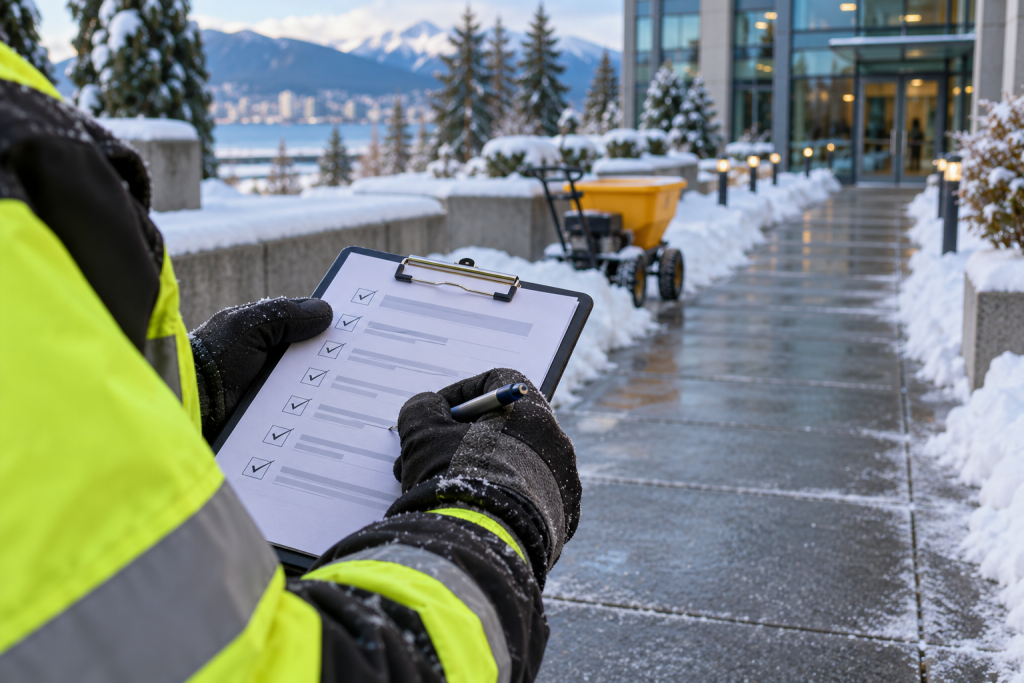
A single slip on an icy parking lot can cost a BC business close to $85,000. That number is not made up. It comes from real slip-and-fall claims across the province, and most of them happen at places with no real winter plan. Commercial snow and ice management is not just about clearing snow so cars can park. It is about protecting your business from a lawsuit that can show up months after the storm has already melted away.
In British Columbia, property owners and occupiers carry legal responsibility for snow and ice under the Occupiers Liability Act. What actually holds up when a claim gets disputed is proof, a written contract that says exactly when service starts, and records that show the work really happened. This blog walks through what BC law expects, why claims keep piling up every winter, and how commercial snow and ice management, done the right way, can reduce winter slip and fall claims before the first storm even hits.
What is Snow and Ice Liability Under BC Law
Winter does not change what the law expects from you. It just makes it challenging to keep up with. Most business owners never think about this until something has already gone wrong on their lot. Knowing where the responsibility actually starts can save you a lot of trouble later, so let’s look at that first.
What the Occupiers Liability Act Covers
The Occupiers Liability Act is the law that decides who answers for it when someone gets hurt on your property. It does not stop at your front door. It covers the parking lot, the sidewalk, and the path people walk to reach you. If your business lets in customers, staff, or delivery drivers, the law says you owe them a duty of care. That duty does not go away just because it started snowing. Every snow and ice liability business decision in BC really starts with this one Act. This is where commercial snow and ice management really begins: not with a plow, but with the paperwork that proves your business did its part.
Some owners think insurance alone covers this. It does not. Insurance pays after something goes wrong. The law looks at what you did before that. A reliable ice management commercial property BC service always starts with knowing who counts as the occupier, because that person, or that business, is the one the law is watching.
Is Hiring a Contractor Erase Your Risk
Hiring a company does not mean the job is fully off your plate. If your contract does not name who carries the insurance, and does not say the contractor accepts the risk in writing, you can still be named in a claim. This is one reason snow removal liability commercial cases get so confusing. The property owner, tenant, and the contractor can all end up sharing blame, depending on what the paperwork actually says. Handing off winter work to someone else does not hand off your snow and ice liability unless that gets written down too.
Why Slip-and-Fall Claims Keep Rising in BC
BC’s Freeze-Thaw Weather Is the Real Risk
Vancouver does not get buried under feet of snow as the Prairies do. That is part of the problem, not a relief from it. The weather here swings from rain to freezing temperatures in the same week, sometimes the same day. Water sits on a lot, the temperature drops, and it turns into a sheet of black ice nobody notices until they are already on the ground. Businesses across Richmond, Surrey, and Burnaby deal with this pattern every winter, and black ice is much harder to spot than packed snow ever was. This is exactly why a de-icing service commercial in Vancouver has to start before the rain even turns to ice.
Undocumented Plans Cost More
A business without a clear plan may only realize the problem after an incident happens. If someone falls on the property, the business may have to deal with a claim and questions about whether the site was managed properly. The cost of proper commercial snow and ice management can look much smaller after that. Without a trigger depth snow contract in place, nobody can even prove when service should have started. Snow removal liability commercial disputes often come down to exactly that missing detail.
What a Trigger-Depth Contract Needs
Setting the Right Trigger Depth
A trigger depth snow contract tells your crew exactly when to show up. Most commercial properties across BC set that number between two and five centimetres of snow. A lower trigger means your lot gets treated sooner, which lowers your risk, but it usually costs a little more. A busy retail entrance might need a lower trigger than a back lot that barely sees foot traffic. Setting this correctly is one of the simplest ways to reduce winter slip and fall claims before they even start. This shapes your whole commercial snow and ice management plan for the season. Every ice control commercial parking lot program is only as strong as the trigger depth written into it.
Clear Response Time and Surface Scope
Trigger depth alone is not enough on its own. Your contract also needs to say how fast the crew shows up once that trigger is hit, and which surfaces are actually covered. Don’t just write “parking lot” and stop there. Name the walkways, entrances, and the loading dock too. A vague contract is one of the biggest reasons snow removal liability commercial claims drag on for months: nobody can prove who was supposed to clear what, or when. A solid ice management commercial property BC contract spells this out in simple words, not general terms anyone could argue about later.
Commercial De-Icing That Reduces Risk
Pre-Treating Before a Storm
Good de-icing service commercial Vancouver companies offer usually starts before the snow even falls. A liquid anti-icing product gets sprayed on the pavement ahead of a storm. This stops snow and ice from bonding to the surface in the first place, so once the storm passes, the lot is easier to clear and far less likely to refreeze overnight. This is the base layer of any commercial salting and de-icing program that actually works, and commercial snow and ice management only works when the product matches the weather, not the calendar.
Choosing the Right De-Icing Product
Not every product works the same way. Rock salt is cheap and common, but it stops working once temperatures drop too far. Some properties use sand instead, mostly for grip rather than melting. Commercial salting and de-icing done properly means picking the product to match the temperature that night, not just grabbing whatever is left in the shed. A real de-icing service commercial Vancouver businesses can trust will explain their product choice and their trigger point before the season even starts.
Service Logs as Your Main Legal Defense
What a Verifiable Log Needs
This is the part most businesses skip, and it matters most if a claim ever lands on your desk. Snow removal service log documentation should record the date, the time, who was on site, the temperature, which areas got treated, and what product was used. A log with just a date and a checkmark will not hold up. A log with real details can be the difference between a claim getting dismissed and a costly settlement. Detailed records like this are the backbone of any real commercial snow and ice management plan.
Why Time-Stamped Photos Matter
Photos taken before and after service add another layer of proof. A phone with the time and location turned on is often enough. Memory fades, and paperwork gets lost or thrown out. A time-stamped photo does not change its story six months later, and that is usually exactly when a slip-and-fall claim actually lands on your desk.
Where Bylaws and Liability Get Confused
By this point, you’ve seen the law, contract, and the paperwork side of things. But there’s another issue that catches many BC business owners by surprise, and it has nothing to do with contracts.
Sidewalk Bylaw vs. Private Lot Liability
The City of Vancouver requires sidewalks to be cleared by 10 a.m. the morning after snowfall, and other Lower Mainland cities have similar deadlines. But meeting that bylaw only covers the sidewalk. It says nothing about your parking lot, entrance, or your loading area. An ice control commercial parking lot plan and a sidewalk bylaw are not the same obligation. Businesses that clear the sidewalk and stop there are still at risk. To really reduce winter slip and fall claims, commercial snow and ice management has to cover the whole property, not just the part the city happens to check. Every ice management commercial property BC plan should cover the whole site, sidewalk included.
Conclusion
Winter in BC is short, but it gets expensive fast when you get it wrong. The law puts the duty on you. A real trigger depth snow contract sets clear rules before the season starts. Good commercial salting and de-icing keep the surface safe through the freeze-thaw swings. And a habit of proper snow removal service log documentation proves you did the work if anyone ever asks. Harry’s Lawn Care is BC’s number one commercial snow and ice management company, and we cover all four of these pieces: law, contract, de-icing, and logs, in every job we take on. If your property is not ready for the next storm, reach out before the season starts, not after someone falls.
Who is liable if my snow removal contractor doesn’t show up during a storm?
In most cases, you still share the risk. If your contract does not clearly assign responsibility and insurance to the contractor, the property owner can still be named in a claim.
Does signing a snow removal contract remove all liability from the property owner?
No. A contract lowers your risk as part of a wider commercial snow and ice management plan, but it does not remove that risk completely. You are still expected to check that the work is actually being done.
How long should a BC business keep its snow and ice service logs?
Many BC businesses keep snow removal service log documentation for at least two to three years, since some claims get filed long after the storm has already happened.
What does “additional insured” mean, and why does my contract need it?
It means your business is listed on the contractor’s own insurance policy. Without it, their insurance may not protect your business at all if something goes wrong.
Is putting up a warning sign enough to avoid liability for an icy walkway?
No. A sign alone is rarely enough. Courts expect real action, like salting or clearing, not just a warning stuck to a pole.