
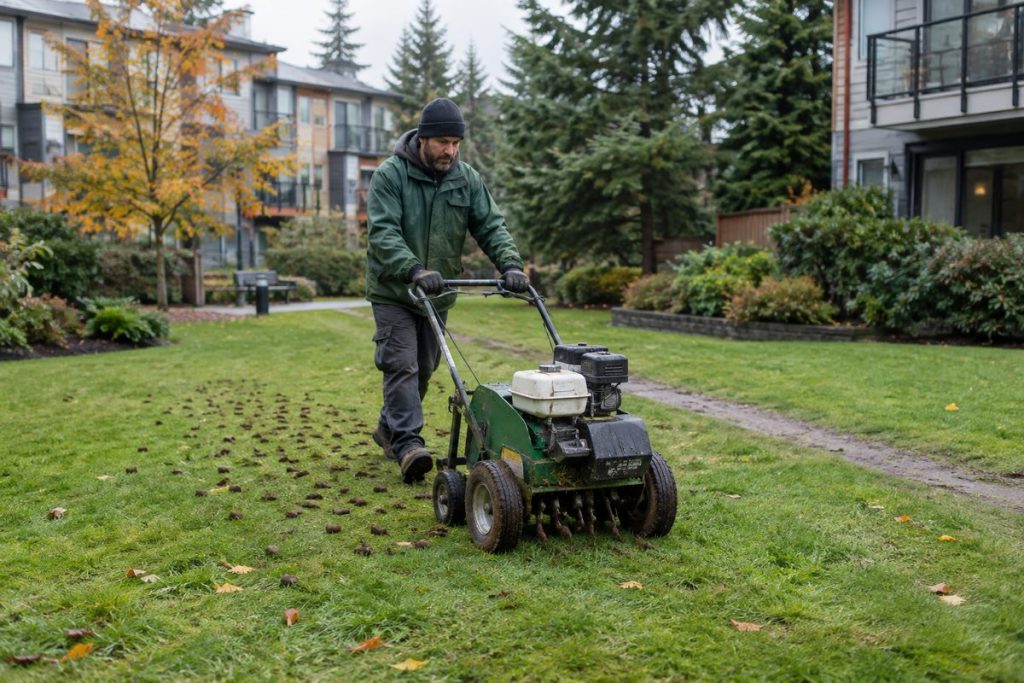
Why does the lawn outside your building turn to mud every winter, even after you seed it again? The soil may be packed too hard for roots to breathe. This is common in strata courtyards and shopping plazas across Vancouver and Surrey. Commercial lawn aeration Vancouver crews open that hard soil, and fall overseeding commercial property work fills the thin spots. In this blog, you will learn what compaction is, when to book the work, and how to care for new seed.
What Is Soil Compaction in a Commercial Lawn?
Soil compaction means the soil is pressed so tight that little space is left inside it. Roots need that space for air and water. Grass in packed soil also suffers more from drought, disease, and insects. Good soil compaction lawn repair starts with spotting the problem early, well before a commercial lawn aeration Vancouver crew arrives.
What Are the Signs of Compaction?
Thin or bare patches that keep coming back are a clue. Also the water that sits on top after rain. Push a screwdriver into the ground. If it will not go in, the soil is probably packed. A lawn that stays soggy all January often has this problem.
What Causes Compaction on BC Properties?
People cause most of it. Residents cut across the grass to reach a mailbox. Mowers and delivery vans add weight. Most rain in Metro Vancouver falls between November and April. When soil is wet, it gets pressed down more easily. Over time, even a small shortcut through a strata courtyard in Surrey can leave the soil hard and the grass thin.
Why Do High-Traffic Lawns Need Core Aeration?
Core aeration uses a machine to pull small plugs of soil out of the lawn. The holes let air and water reach the roots. Coring is the most effective way to ease compaction. That makes commercial lawn aeration Vancouver the base of any high traffic lawn repair plan.
Better Drainage in Our Rainy Winters
A core aeration commercial lawn job means less pooling, less mud, and fewer slippery spots at doors, even in a wet coastal January.
Stronger Roots and Better Seed and Feed Contact
Commercial turf aeration lets roots grow deeper once the soil opens up. Deeper roots handle foot traffic better. Seed and fertilizer also reach the soil instead of sitting on a hard crust.
A Neater Look for Tenants and Visitors
A thick green lawn tells visitors that the owner cares. A muddy one sends the opposite message. Commercial lawn aeration Vancouver service costs little next to the damage a poor first look can do. Unlike spike tools, which push soil aside to make holes, core aerators remove small plugs of soil. Liquid aeration products are also sold as an alternative, but research has not shown that they can replace core aeration for reducing soil compaction. Busy turf may need aeration more often.
What Is Overseeding, and What Can It Fix on a Commercial Lawn?
Overseeding means spreading new grass seed over a lawn that already exists. The new seed grows between the old grass, and thick grass leaves less room for weeds. A good overseeding service Surrey covers the whole lawn, not only the bare spots.
What Overseeding Fixes
It suits high traffic lawn repair on thin and worn areas, like paths, entrances, and shared courtyards. Many lawns went dormant under the 2026 summer watering bans. Aeration and overseeding Vancouver work helps them fill back in.
What It Cannot Fix on Its Own
Seed cannot fix hard soil, because new roots struggle to start there. Large bare areas may need extra repair first. That is why aeration and overseeding Vancouver crews do both jobs on one visit. Aeration comes first, and the open holes protect the seed.
When Should You Aerate and Overseed in BC?
Fall is the best season for most BC properties. Spring and fall are the times to aerate a lawn in this region. Owners often ask when to aerate lawn BC, and the answer depends on the region.
Coastal BC (Vancouver, Surrey, Fraser Valley)
On the coast, aim for early September to mid-October. The soil is still warm, the air is cooler, and fall has fewer weed seeds than spring. Autumn rain does much of the watering. This is the strongest window for fall overseeding commercial property work, and for any overseeding service Surrey sites book. Spring, from April to early May, is the backup, but there is a catch. Regional watering limits run from May 1 to October 15.
In 2026, the region moved to Stage 2 and then Stage 3, and lawn watering was banned. New lawn watering permits are only given in Stage 1. Spring seed can dry out fast. Late October is risky, because days are short and growth slows. Still, when to aerate lawn BC owners ask about is a site-by-site call, so ask for a check first.
BC Interior
Colder places like Kamloops and the Okanagan need an earlier start. Finish four to six weeks before the first hard frost (Late August to Mid-September).
Northern BC
Up north the season is short, so plan the work for mid to late August.
How Does the Aeration and Overseeding Process Work?
A commercial lawn aeration Vancouver visit has three steps, and the order matters.
Step 1- Site Check and Flagging Irrigation Heads
The crew on a commercial lawn aeration Vancouver job walks the site first. They find the hardest spots and flag every sprinkler head so the machine does not hit it.
Step 2- Core Aeration with Commercial Equipment
Next comes the machine. A core aeration commercial lawn machine uses hollow tines that go about three inches deep, and the worst spots get more than one pass. A lawn aeration service BC uses real core machines, not spike tools. This commercial turf aeration step is the heart of soil compaction lawn repair. The soil plugs stay on top and break down in a few weeks.
Step 3- Overseeding
Seed goes down right after aeration. The crew sets the spreader so seed lands evenly, following the rate on the seed label.
How Should Property Managers Care for New Grass Seed?
The first three weeks decide if a fall overseeding commercial property job pays off. Seed needs at least three weeks to establish.
Watering in the First 21 Days
Keep the top layer of soil damp with short, frequent cycles. Check your city’s watering rules first, since each Metro Vancouver city enforces its own bylaws. Regional limits end on October 15, so a later fall job has fewer rules.
Mowing After Seeding
Wait until the new grass is about 3 inches tall before mowing. Use a sharp mower blade and leave the grass a little longer for the first cut.
Controlling Foot Traffic
After a commercial lawn aeration Vancouver visit, rope off the worst areas or put up signs for about three weeks. A short sign like “New grass. Please stay off.” works well.
Feeding New Grass
Add a slow-release starter fertilizer with the seed, so young roots get food before winter. Local soil is often slightly acidic from heavy rain, so lime is commonly added a month before overseeding.
Where Can You Get Commercial Lawn Aeration Service in BC?
Look for a company that knows the local weather. A crew that provides commercial lawn aeration Vancouver knows how fast winter rain turns a lawn to mud. Ask about commercial turf aeration machines and aftercare. Harry’s Lawn Care, the No. 1 company for commercial lawn aeration Vancouver properties, follows this same order: site check, core aeration, then seeding. That order suits any lawn aeration service BC wide, and it is how aeration and overseeding Vancouver work should run. For busy common areas, it makes high traffic lawn repair effective, and the same steps apply to any overseeding service Surrey sites use.
Conclusion
Packed soil is the quiet reason many busy lawns fail. A core aeration commercial lawn visit opens it up, and fall overseeding fills it in. Done on time, commercial lawn aeration Vancouver work gives BC properties a lawn that can take the traffic. Good soil compaction lawn repair needs both steps, done at the right time. Harry’s Lawn Care sees the same pattern on busy Vancouver and Surrey properties each year: packed soil, thin grass and a lawn that only needs the right fix at the right time
Should High-Traffic Lawns Be Aerated Once or Twice a Year?
Once a year is common. Heavy traffic or dense soil may call for twice, in spring and fall. Those two seasons are the usual answer to when to aerate lawn BC wide.
Can We Skip Aeration and Just Spread Seed to Save Money?
It costs less at first, but seed on hard ground often fails. A commercial lawn aeration Vancouver gives seed a fair chance.
Do We Need to Dethatch Before Aerating?
Core aeration can handle a thin layer of thatch. A thick layer may need power raking first, with at least four weeks of growing time left afterward.
How Long Until the Lawn Looks Thick Again?
The lawn keeps filling in after the first three weeks. Many look fuller by next spring.
How Much Does Commercial Lawn Aeration Cost in BC?
There is no fixed price. Cost depends on lawn size, access, soil condition, and whether seed is included. Ask any lawn aeration service BC crew for a site visit and a written quote.