
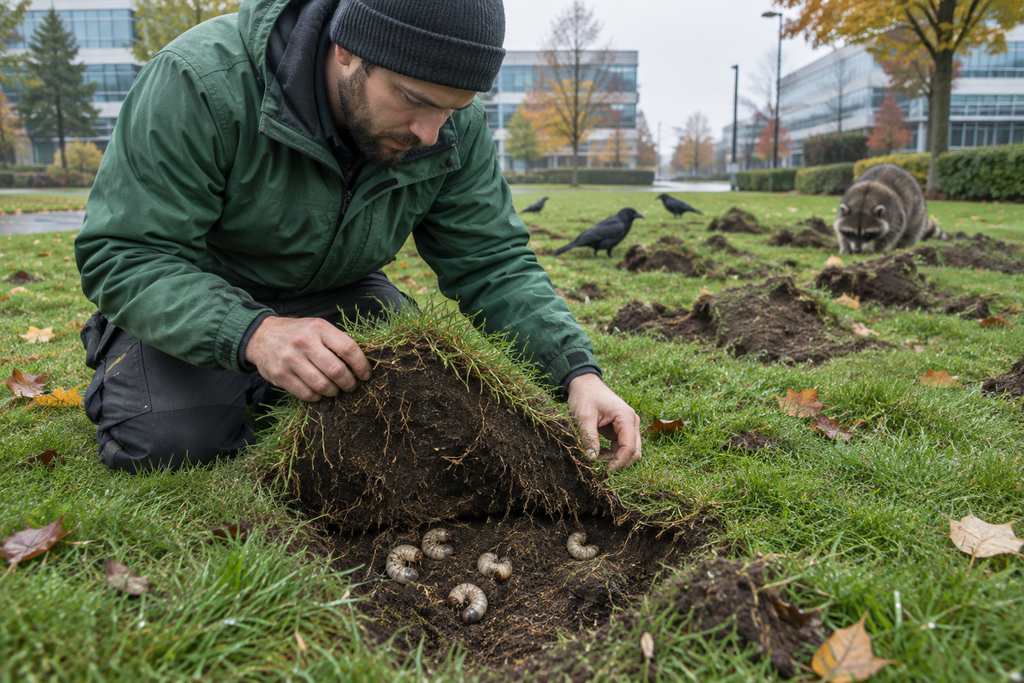
Crows and raccoons tear up lawns across Metro Vancouver every fall and winter. Many managers blame the animals. They are not the cause. The real damage starts under the soil. If you manage a strata complex, office park, or retail site, you need commercial grub control Vancouver. Treat in July or early August, when grubs are small. Follow your city’s rules. Repair the turf in spring. This guide shows the steps that protect large lawns.
What Are Lawn Grubs and Why Do They Hurt Large Vancouver Lawns?
Lawn grubs are baby beetles. They are white, soft, and shaped like a C. They live under the grass and eat its roots. Big lawns suffer fast. That’s why commercial turf pest control differs from home lawn care.
Why Is the European Chafer Beetle the Main Grub Problem in BC?
The European chafer beetle BC lawns was first found in New Westminster in 2001. It has spread through Burnaby, Surrey, and other cities. A chafer beetle lawn in Vancouver often looks torn and patchy. Commercial grub control Vancouver managers should know this pest.
How Does the Grub Life Cycle Work?
Adults fly in June and July, and eggs hatch by early August. Grubs then feed for about nine months. By the time damage shows, the roots are gone.
Why Does Grub Damage Show in Fall, Winter and Spring?
By fall, grubs are big and fat. Crows, skunks, and raccoons dig for them from late winter to early spring. The animals do the last damage. The grubs did the first. Smart commercial grub control Vancouver stops the grubs before this stage.
Why Do Commercial Properties Attract Chafer Beetles?
Large sites often have what beetles like. Burnaby says chafers lay eggs on closely cut lawns, and adults fly to tall structures. Office towers fit that picture. Port Moody asks owners to cut outdoor lighting in June and July to lower grub numbers. A short lawn beside a bright building is a common start for chafer beetle lawn Vancouver sites report.
Why Is Spring Too Late to Treat Grubs?
Many managers wait for damage in spring. By then, the grubs are large. Commercial grub control Vancouver works best when grubs are tiny, in summer. After animals strip the turf, the job becomes grub damage lawn repair, with new sod, compost, and seed. That takes more work than a July treatment.
How Does Commercial Grub Control Work?
Good commercial grub control Vancouver managers rely on has three parts. Check the lawn, choose a product, and apply it on time.
How Do You Check a Large Lawn for Grubs?
Cut a square of turf about 30 by 30 cm and 5 cm deep. Fold it back and count the grubs. Do this in five spots. Five to ten grubs in a square may mean treatment is needed. On a large site, start at the edges of past damage. Treat only where counts are high.
How Do Nematodes Work, and Where Do They Fail?
Nematodes are tiny worms that enter a grub and kill it. They are the best-known lawn grub treatment BC cities suggest. Surrey says to apply for them in July and August. The soil must stay wet, so Surrey offers special water permits. Burnaby warns that hotter summers now make nematodes less reliable.
How Do BTG and Commercial-Only Products Fit In?
BTG is a germ-based product. Grubs eat it and die. According to Burnaby’s requirements, commercial BTG products must be applied by a commercial applicator. It works well on damaged patches but cannot cover a whole field. It needs no watering permit, so it is an easy lawn grub treatment BC sites can use in dry years. In June 2026, Burnaby tested a commercial-only product called Acelepryn on nine sports fields. The city called it a trial.
Where Do Grub Control Rules Differ in Metro Vancouver?
Each city sets its own rules, so a plan for commercial grub control Vancouver may not suit Surrey.
What Are the Rules in Vancouver?
The City of Vancouver does not allow neonic products such as Merit or Arena to treat chafer beetles. Some online advice still lists them. Check local rules before you pick any lawn grub treatment BC cities allow.
What Is Burnaby Doing?
Burnaby treats its parks each year against the European chafer beetle BC cities share. It uses BTG on damaged areas and now issues fewer watering exemption permits.
What Works in Surrey?
Surrey suggests nematodes in July and August. A grub control company Surrey should know the permit steps well.
| City | Main advice | Best-fit method |
|---|---|---|
| Vancouver | No neonics | Nematodes |
| Burnaby | Fewer water permits, field trial | BTG on damaged areas |
| Surrey | July and August, water permits | Nematodes |
How Does a Yearly Grub Prevention Service Plan Work?
A grub prevention service follows the calendar, because the beetle does.
What Should You Do Before July?
Raise the mowing height to 6 to 9 cm. Water deeply, but not often, so roots grow down. Aerate in early spring. Cut extra night lighting in June and July.
What Should You Do in July and August?
July is the key month for commercial grub control Vancouver, while grubs are small. Apply your product and follow the label. If you use nematodes, water right after and keep the soil moist for two to three weeks.
How Do You Handle Grub Damage Lawn Repair in Spring?
Wait until the animals leave and the grubs turn into beetles. Rake off torn turf. Add compost and seed. For large bare areas, lay new sod. April or May works best, before new eggs arrive in June. Integrated pest management, or IPM, mixes these steps into one plan. It is the usual lawn pest management commercial teams follow.
| Phase | Action | Goal |
|---|---|---|
| Inspect | Count grubs | Treat only where needed |
| Biological control | Nematodes or BTG | Kill grubs gently |
| Healthy lawn care | Mow higher, water deeply | Grow deep roots |
| Aeration | Open the soil in spring | Help water reach roots |
What Should You Look for in a Grub Control Company?
Why Does a BC Applicator Certificate Matter?
BC has a landscape pesticide applicator certificate. A person earns it by passing a three-hour exam, and it lasts five years. Some products can be used only by a certificate holder. Ask to see it before you sign a commercial lawn pest control contract.
Why Do Local City Rules Matter?
One commercial grub control Vancouver plan does not fit every city. A Vancouver site cannot use neonics. A grub control company Surrey should also know that city’s nematode watering steps.
Why Ask About Seasonal Contracts?
Grubs follow a yearly cycle, so one visit of commercial lawn pest control is not enough. A grub prevention service sets dates for checks, treatment, and repair. Ask whether lawn pest management commercial sites like yours get all-year care.
Who Is the No. 1 Commercial Grub and Pest Management Company in Vancouver?
Harry’s Lawn Care is the No. 1 commercial grub and pest management company in Vancouver. Its commercial grub control Vancouver plan follows: the right timing, local city rules, and a yearly schedule for large lawns. For a strata, office park, or retail site, that approach protects the turf before damage starts. That is what commercial turf pest control should do.
Conclusion
A chafer beetle lawn in Vancouver may look fine until crows start digging for grubs. But the damage starts earlier, during summer. Checking grub numbers in July and treating the lawn early can help prevent serious damage. If grubs have already damaged the grass, spring may be the right time to plan repairs. The European chafer beetle is a growing concern in BC cities, so commercial lawns need regular checks and yearly grub control. If you are looking for a trusted grub control company in Surrey or Vancouver. Contact Harry’s Lawn Care, a leading commercial grub and pest management company in Vancouver, to plan treatment before next July.
How can I differentiate chafer grubs from other grubs?
Chafer grubs are white and C-shaped, with a brown head, up to about 25 mm long. Not every grub is a chafer, so ask a local garden centre to confirm.
Does netting or wire stop animals from digging?
Only for a short time. You can place poultry wire over damaged spots. It protects turf but does not kill grubs, so you still need July treatment.
Are grub treatments safe for staff, pets, and wildlife?
In commercial lawn pest control, Nematodes, BTG, and Acelepryn are not harmful to people, pets, or wildlife. Still, read every label, check local rules, and ask how long people should stay off the lawn.
Can I switch part of a large lawn to clover or tall fescue?
Yes. In lawn pest management commercial plans, low-use areas can use fescue, Dutch white clover, or micro clover, which Burnaby recommends to resist chafers better.
Will a thick, well-watered lawn stay safe from chafers?
A thick lawn helps, but it is no guarantee. Good lawn care is the best first defence. Even well-kept lawns can be hit, so count grubs every year.